
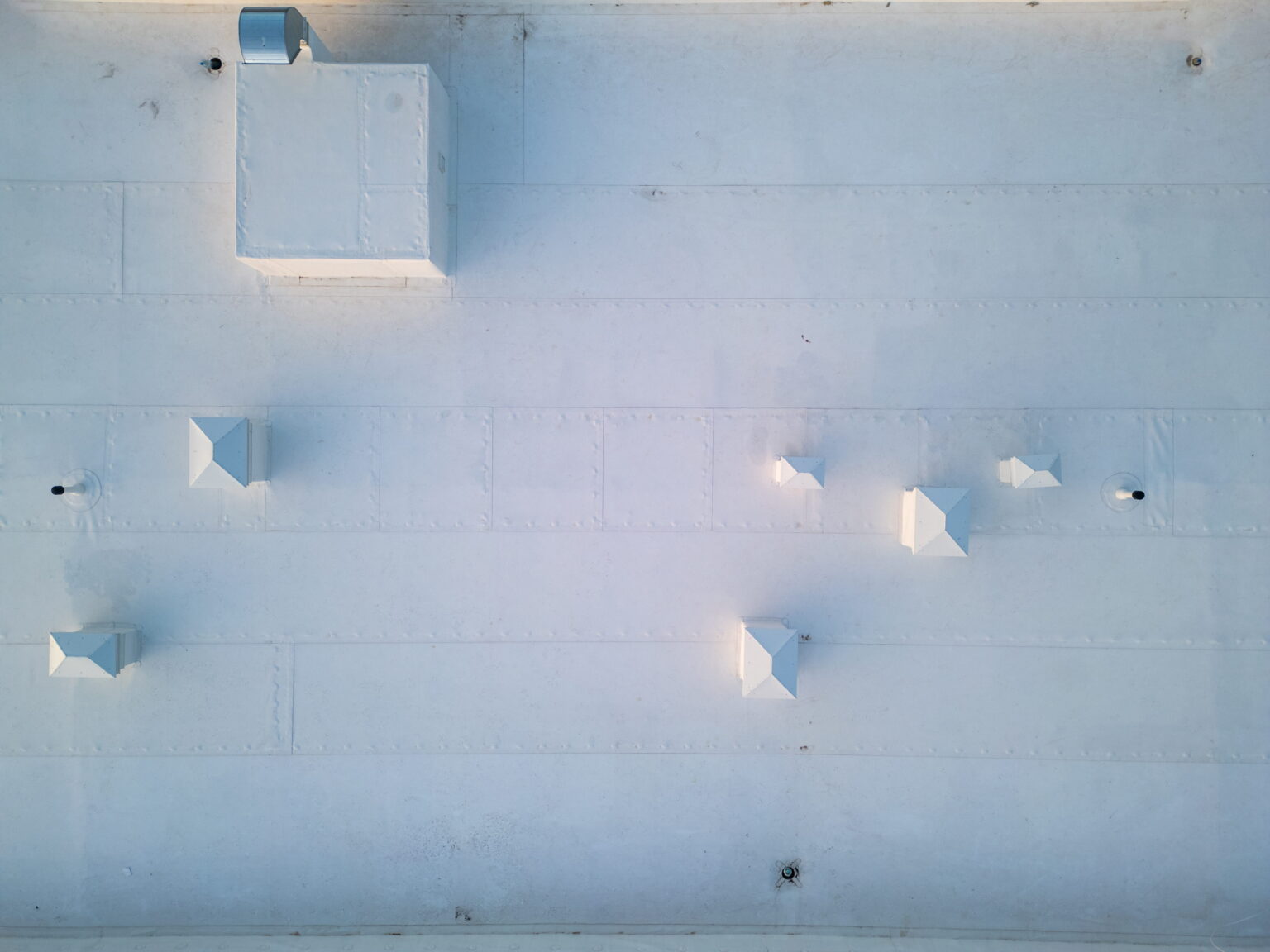
Texas leads the nation in severe weather events, leaving business owners to deal with the costly aftermath of sudden storms. While shattered skylights and torn membranes present obvious problems, the most dangerous consequences of a storm often remain invisible to the naked eye. Traditional physical inspections frequently miss subtle structural compromises, which later evolve into catastrophic failures. Fortunately, cutting-edge technology now offers property owners a powerful defense against hidden commercial roof hail damage. By utilizing thermal drone mapping, savvy managers can identify subsurface moisture, validate insurance claims, and protect their investments before minor issues escalate into major liabilities.
How Texas Hail Destroys Subsurface Insulation
When large hail strikes a low-slope commercial roof, the impact creates immediate, localized stress. While the top single-ply membrane might appear unpunctured, the underlying cover board and insulation often suffer severe micro-fractures. Consequently, these hidden fractures compromise the structural integrity of the roofing system.
Over time, rainwater seeps through these microscopic tears and saturates the insulation below. This trapped moisture slowly degrades the R-value of the building, which drives up monthly energy costs. Furthermore, the constant presence of water rots the structural deck from the inside out. Because this process happens beneath the surface, property owners rarely notice the commercial roof hail damage until interior ceiling tiles begin to stain and drip. By that time, the facility requires expensive, large-scale remediation rather than a simple patch repair.
How Thermal Drones Reveal Subsurface Moisture
To combat this invisible enemy, commercial roofers now deploy advanced drones equipped with Forward-Looking Infrared (FLIR) thermal cameras. This technology relies on basic thermodynamics to expose hidden commercial roof hail damage without disrupting daily business operations.
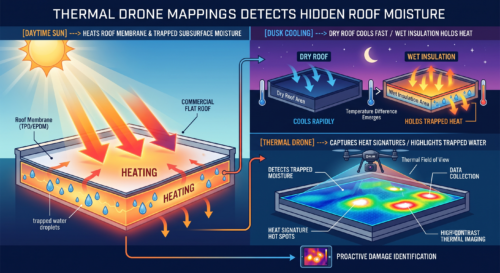
During the day, the Texas sun heats the entire roof surface uniformly. As the sun sets at dusk, the dry sections of the roof shed heat rapidly and cool down. Conversely, the areas with saturated insulation retain heat much longer because water possesses a high thermal mass.
As the drone flies overhead, the FLIR camera captures these distinct temperature differentials. The resulting thermal map displays wet insulation as bright, glowing hot spots against a dark, cool background. Therefore, aerial thermography provides an objective, photographic record of exact moisture intrusion points, transforming guesswork into precise science.
Winning the Insurance Battle with Data
Filing an insurance claim for commercial roof hail damage often turns into a frustrating battle of opinions. Insurance adjusters frequently deny claims by arguing that the roof shows no visible exterior punctures. However, property owners can tilt the scales in their favor by presenting an unarguable, data-driven drone report. Use the following toolkit to secure full coverage before your policy’s claim window closes:
-
Request a Baseline Scan: Arrange a thermal drone flight immediately after any major storm event to document the immediate impact.
-
Compile a Dual-Image Report: Ensure your roofing partner provides a report that pairs high-resolution aerial photographs with matching thermal imagery.
-
Correlate the Data: Use the thermal hot spots to guide targeted core sampling, which physically verifies the presence of moisture.
-
Submit Definite Proof: Present the comprehensive digital map directly to the adjuster to eliminate any subjective debate regarding the scope of the destruction.
Protecting Your Asset Before the Claim Window Closes
Texas insurance policies impose strict time limits on storm damage reporting, typically requiring filing within one to two years. Because subsurface moisture accumulates slowly, waiting for an active interior leak usually means missing this critical filing window. Once the deadline passes, the financial burden of replacing saturated insulation falls entirely on the property owner.
Proactive thermal scanning identifies commercial roof hail damage within days of the storm. As a result, facility managers can submit undeniable proof to their insurance carriers immediately. This swift action ensures that insurance companies cover the true extent of the loss. Ultimately, adopting thermal drone mapping allows Texas businesses to mitigate long-term structural risks, streamline the claims process, and maintain the longevity of their commercial properties.