
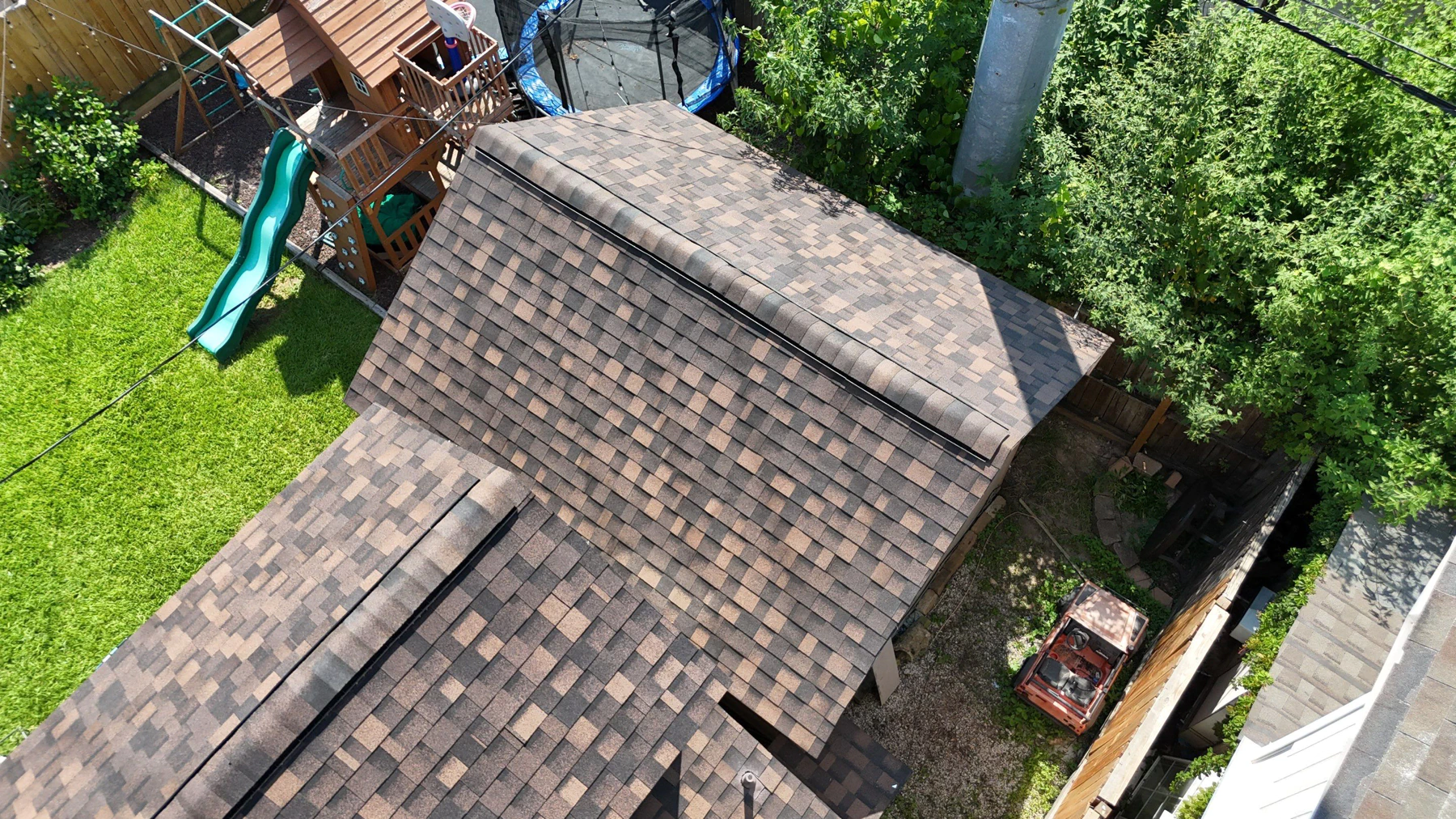
You clean the gutters and the bucket has sand in the bottom. Every asphalt roof sheds some of that. The amount, and the company it keeps, tells you whether you are looking at a new roof settling in or an old one giving up.
The first year
Factory-fresh shingles carry loose granules that never fully embedded. The first hard rains wash them into the gutters. A light grit, with the roof still evenly colored and no bald spots, is ordinary. It should taper off, not accelerate.
Years later
Piles at the downspout, bald patches you can see from the yard, and granules stuck in the corners of the driveway after every storm mean the surface is eroding. Hail does this in a night: splatters of missing granules, often with a dark center if the mat took the hit. Age does it slowly, worse on the south and west. Either way, the asphalt underneath is now in the sun, and sun is what finishes a shingle in this climate.
Do not decide from the gutter alone. Bald spots with soft centers are hail. Even thinning with curl at the tabs is age. We look at both on a roof inspection before anyone talks about a claim or a roof replacement.
What not to do with the grit
Do not rinse the gutters and then try to remember how much was there. Bag a scoop, photograph the downspout, and photograph the slope above it in the same light. If you are filing a claim, those photos are the “before someone cleaned up” record.
Do not let a contractor brush granules off to make a spot look worse, and do not seal bald spots with a tar brush the day before an adjuster arrives. Both change the evidence. A clean photo of an honest roof is worth more than a touched-up one.
If the gutters filled up after a storm you can name, grab the Houston homeowner storm checklist and photograph the downspouts before you rinse them. Then request a free inspection or call (281) 541-0027.